California’s remote, rural communities are facing a critical loss of maternity services. Often, the only maternity care provider in these areas is a critical access or frontier hospital. Plumas District Hospital was the last frontier hospital in California to offer maternity services.
In July 2021, town hall forums were held to assess community needs. The feedback was clear: Plumas County women want and need local maternity and childbirth services, with many expressing a desire for a freestanding birth center option.
Although labor and delivery services were suspended in 2022, the strong support from the community inspired the hospital administration and medical staff to continue their efforts.
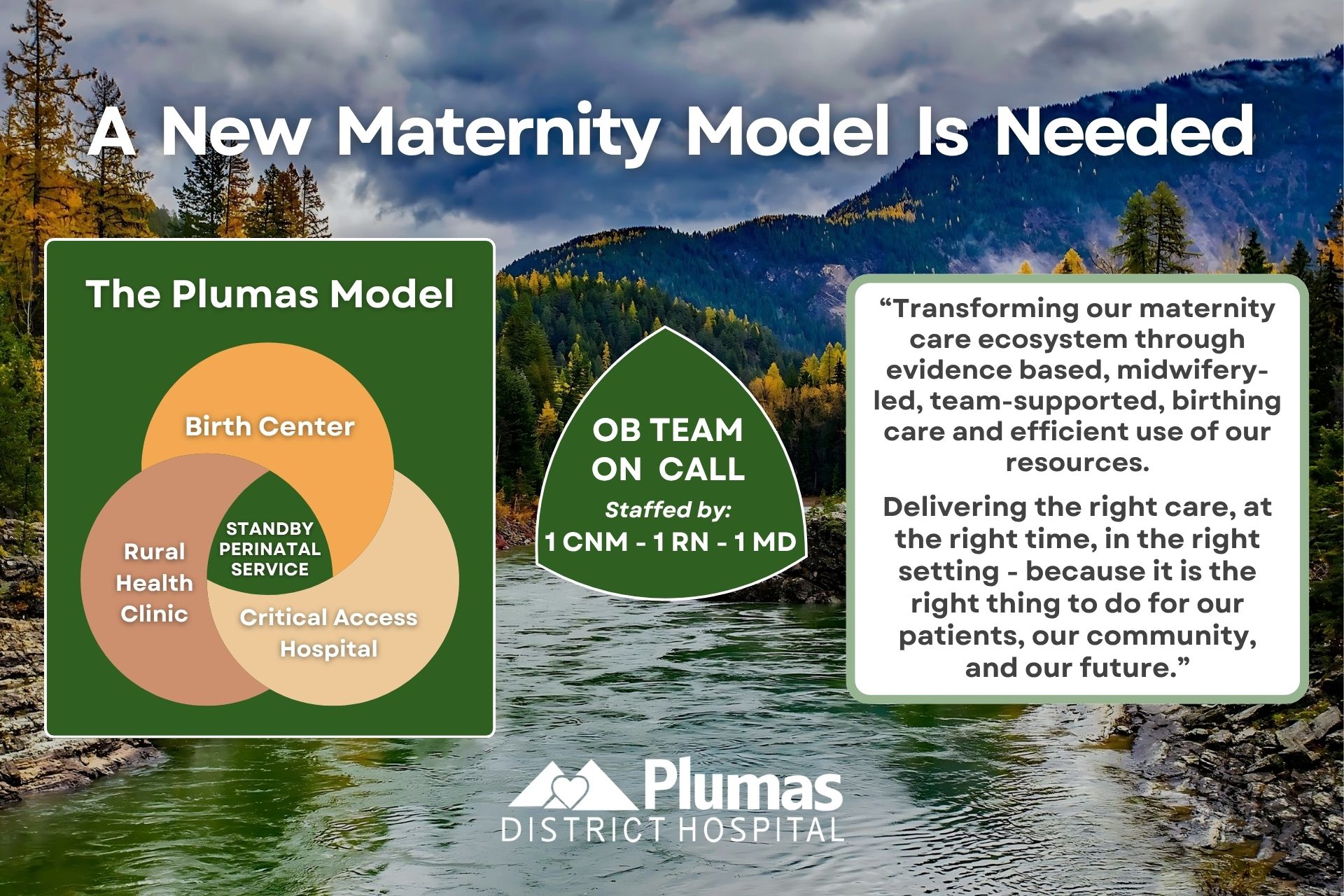
This determination led to the creation of The Plumas Model.
Be part of the Future of Rural Maternity Care.
Are you a Registered Nurse (RN) or Certified Nurse-Midwife (CNM) passionate about expanding access to maternity care in rural communities? We invite you to connect with our team to learn more about The Plumas Model, our vision for local maternity services, and opportunities to get involved.
Reach out to our team to learn more: [email protected], [email protected], [email protected], [email protected].
Plumas Model Frequently Asked Questions
- Preserve access to local prenatal and post partum care for all expectant mothers.
- Reintroduce childbirth services for low-risk expectant mothers in a freestanding birth center.
- Maintain competent obstetrical trained providers in the community.
- Enhance recruitment and retention efforts.
- This will be especially true for certified nurse midwives as it provides a venue in which they can practice to the full extent of their scope of practice.
- Triage and refer expectant mothers to get the right care in the right setting at the right time.
- Utilize a Regional Perinatal Network.
- Use of telehealth in the clinic and ED for perinatal and neonatal consultation.
- Education and case management for expectant mothers and families.
- Care is local.
- Decrease disease and death for mom and baby.
- Decrease need for transportation for some families.
- Community viability, support young families, more attainable for families/household budget
- Keeps young families in the community.
- Maintain competent obstetrical trained providers in the community.
- Preserves local prenatal and postnatal care supports a healthy hospital financial position by increasing visits and diagnostic tests and procedures.
- Cost for staffing are shared among the rural health clinic, birth center and hospital, providing financial stability.
- There will be an increase in revenue due to the new service line with additional office visits and diagnostic tests and procedure.
- We believe that this model can be replicated in other rural areas.
- Levels of Obstetrics Care Consensus Levels of Maternal Care
- Signal Functions Monitor Indicator Sheet Monitor Indicator sheet Availability of functional emergency obstretric.pdf
- AABC opinion Distance: How Far is Too Far?
- AABC Standards (RV2017)
- The Plumas Model: PowerPoint Presentation NRHA 2026
- Shuttering of Maternity Care Centers in Northern California
- Maternity Care Deserts on the Rise in California | KQED
- California Health and Safety Code § 1256.05 (2025)
- California Health and Safety Code § 1256.06 (2025)